

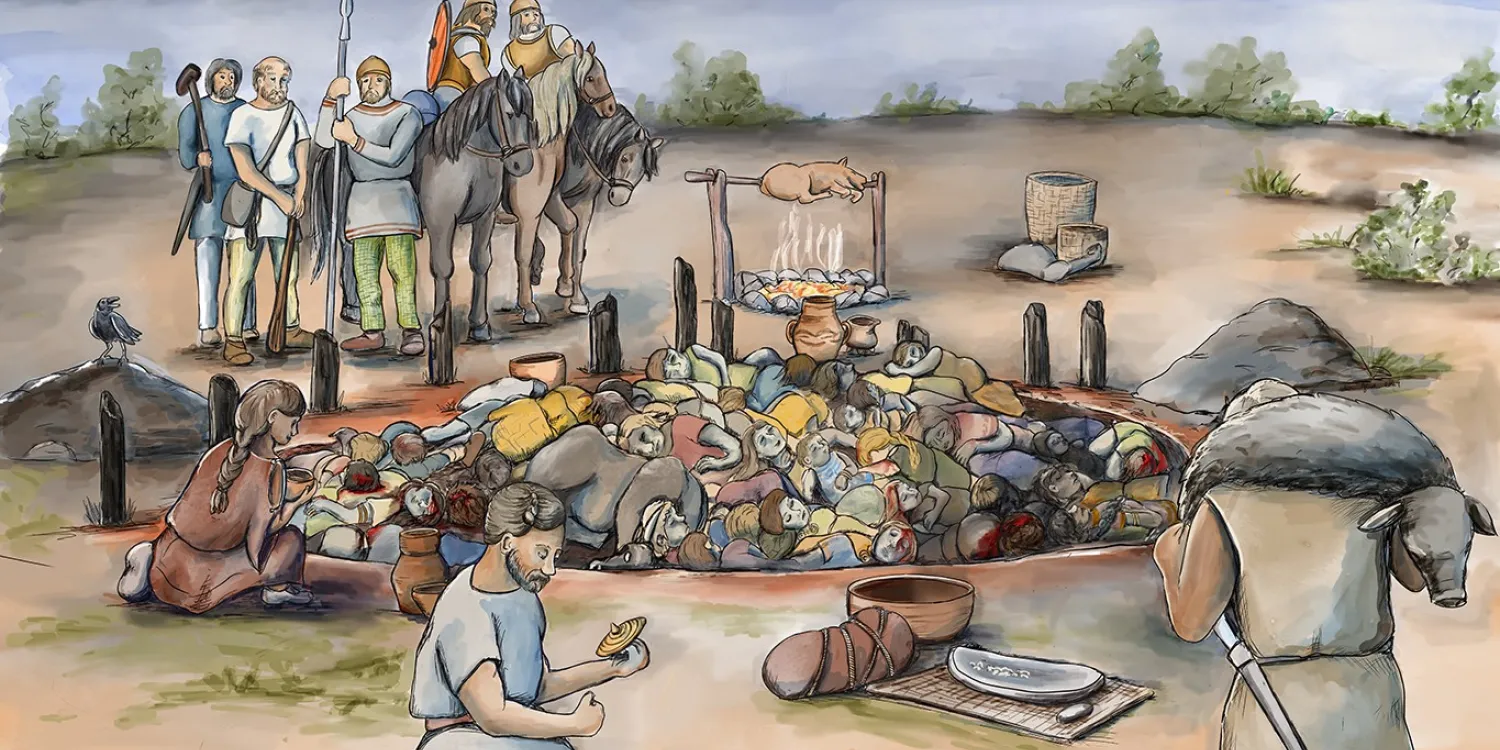
Research has shed new light on events behind the Gomolava burials, in Northern Serbia, one of the largest prehistoric single-event mass graves excavated in Europe.
The majority of the remains of more than 77 individuals found in the grave located in the south Carpathian Basin were of women and children.
Genetic analysis
The study co-led by the University of Edinburgh, University College Dublin and the University of Copenhagen, and funded by the European Research Council, provides new evidence the people buried together around 2800 years ago experienced violent deaths, including bludgeoning and stabbing.
Unexpectedly, the genetic analysis revealed very few victims were related to each other. Isotopic analysis of their bones suggests they grew up in different settlements entirely.
In contrast to other mass graves of the time period, the site showed evidence of investment of time and resources in its preparation, experts say.
Protected location
People were buried with their personal items, including jewellery produced from metal stocks from this area.
The grave was found in a protected location with evidence of personal bronze ornaments, ceramic drinking vessels and the bones of 50 to 100 animals.
Some animals were evidently slaughtered or butchered for the burial event, including the skeletal remains of a calf found at the bottom of the grave pit.
Iron Age violence
Evidence of broken quern stones – remnants of ancient grinding tools used for milling grain – and concentrations of burnt seeds were found on top of the grave.
The predominance of women and younger individuals in the mass grave is exceptional in European prehistory, adding a new dimension to understanding Iron Age violence, researchers say.
The investment in its presentation reveals the importance of the burial event prior to covering the dead with soil and stone. This made a place for remembrance of the killing for the community, they add.
International team
The international team and researchers from the Museum of Vojvodina in Novi Sad, Serbia used techniques including DNA analysis, the study of tooth collagen and enamel and the bioarcheological investigation of human bones for evidence of trauma and injuries.
They found 40 of the individuals were 1 to 12-years-old, 11 were adolescents and 24 were adults – 87 per cent of which were female. The only baby that was found was male.
Biomolecular analysis of 25 of the individuals provided information about ancient diets, migration patterns, health conditions, and social interactions.
Targeted killing
The findings showed that the deceased originated from a diverse range of places and had different diets, suggesting they were not related, nor had lived together long-term in a single settlement.
Researchers say the killing event took place at an unsettled time when communities were becoming less mobile in their landscapes and creating new, enclosed settlements and reoccupying Bronze Age settlement mounds and parts of mega-forts.
The early collective violence against the women and children was most likely from targeted killing as part of a systemic and large-scale conflict that many settlements got caught up in.