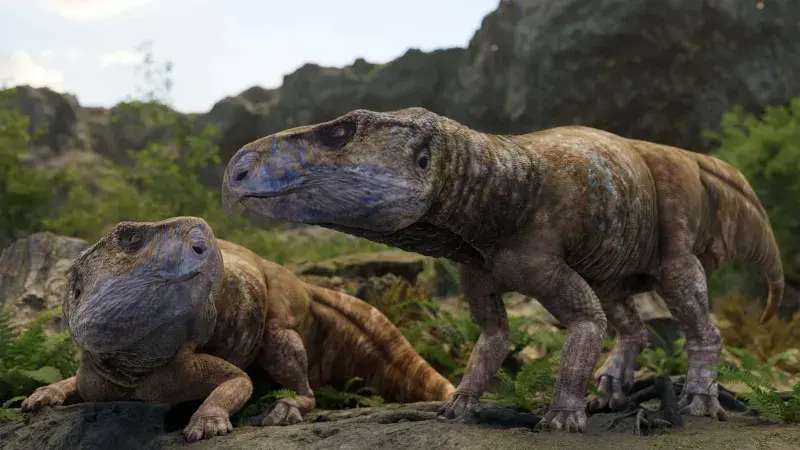
Horned dinosaurs roamed prehistoric Europe, study shows
Edinburgh scientists have helped solve a long-standing puzzle about the history of horned dinosaurs in Europe, a study suggests.
Researchers have found the first compelling evidence that horned dinosaurs lived in Europe in the Cretaceous period.
While Triceratops and other horned dinosaurs – known as ceratopsians – were widespread in North America and Asia, only a handful of poorly preserved, controversial fossils have previously been found in Europe, researchers say.
Now, new research has confirmed that a fossil found in Hungary was a ceratopsian, filling a major knowledge gap about the journey of these dinosaurs across the northern hemisphere.
Controversial fossil
First described in 2010, Ajkaceratops was considered by some experts to be a horned dinosaur, while others interpreted it as being a relative of a different type of dinosaur, called Iguanodon.
Now, analysis of newly discovered Ajkaceratops fossil material has helped the research team, led by palaeontologists from the Natural History Museum, confirm that the dinosaur was a ceratopsian.
The dinosaur lived around 84 million years ago during the Cretaceous Period, when Europe consisted of a series of islands, the team says.
The team’s analysis also reveals that some other dinosaurs thought to belong to a different family of dinosaurs – called rhabdodontids – had been long misclassified and were also ceratopsians.
While Iguanodon and Triceratops look very different, the groups they are part of both evolved from a common ancestor, meaning they’ve both inherited certain characteristics. They also independently evolved four-leggedness, complex chewing mechanisms and a large body size. This means that their teeth and limbs look quite similar, both because of their shared history and way of life. So, when we only have small parts of the skeleton to look at, it can be quite difficult to tell what’s what.
Professor Susannah Maidment
Lead author, Natural History Museum
Evolutionary puzzle
Previous research had shown that the earliest ceratopsians evolved in Asia before spreading to North America, where they evolved into species such as Triceratops.
The easiest route for these dispersals would have been through Europe, but the lack of fossils had challenged this idea, the team says.
Horned dinosaurs like Triceratops are some of the most iconic dinosaurs but most of them are from North America, and now we've found them in Europe, hiding in plain sight because they've been misidentified for decades as other types of dinosaurs.